GEO & AI Visibility Spoke — built to be a definitive, cite-worthy resource for business owners who want to optimize for AI assistants and earn consistent source visibility.
How do I optimize my website for ChatGPT and Perplexity?
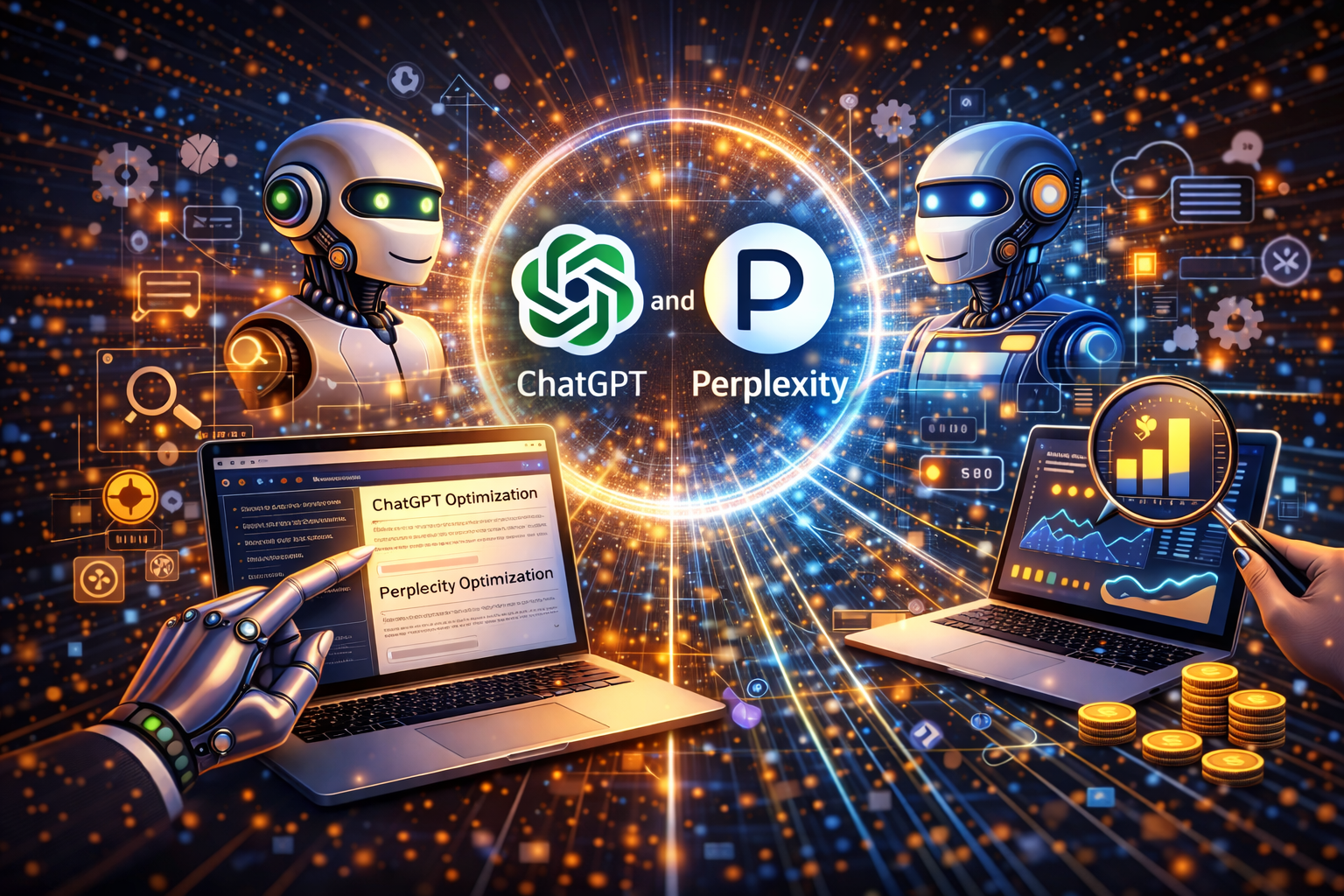
Direct Answer: To optimize your website for ChatGPT and Perplexity, publish answer-first pages that are easy to extract, prove claims with steps and credible references, reinforce your brand as a clear entity with consistent identity signals and schema, keep your technical SEO clean so crawlers trust the canonical version, and then measure “citation share” across a tracked set of questions so you can improve what these systems actually choose to cite.
AI assistants changed how people research. Therefore, “visibility” now includes being cited in answers, not only ranking as a link. Additionally, these systems often show sources, which means you can earn trust and demand even before a visitor clicks. Consequently, your goal is to become the easiest, safest source to cite for the questions your buyers ask.
This spoke supports the hub: Generative Engine Optimization (GEO) & AI Visibility. Additionally, it connects naturally with What is GEO vs SEO? and How to get cited in Google’s AI Overviews.
Table of Contents
- What “optimize for ChatGPT and Perplexity” actually means
- How ChatGPT and Perplexity use sources and citations
- The 5 pillars of AI-assistant optimization
- Pillar 1: Answer architecture for fast extraction
- Pillar 2: Entity clarity and trust signals
- Pillar 3: Proof packs that reduce citation risk
- Pillar 4: Technical SEO that prevents source confusion
- Pillar 5: Distribution and corroboration without spam
- A spoke-page blueprint built for citations
- Which content types earn citations most often
- Should you add llms.txt and how to use it responsibly
- How to measure performance: citation share and assisted impact
- Troubleshooting: why you are not being cited
- Internal links to related hubs and spokes
- External authority references
- FAQ
What “optimize for ChatGPT and Perplexity” actually means
Direct Answer: Optimizing for ChatGPT and Perplexity means making your content and brand signals easy to retrieve, verify, summarize, and cite, so your pages become preferred sources when users ask questions in AI assistants.
Traditional SEO focuses on ranking and clicks. However, AI assistants often deliver an answer first, and then show sources. Therefore, your “unit of competition” becomes the answer block and its citations, not only the results page.
In practical terms, optimizing for ChatGPT and Perplexity means you build pages that:
- Answer one question clearly: so the assistant can match the query to your page.
- Offer structured, quotable passages: so extraction is easy and accurate.
- Prove important points: so citing you feels low-risk.
- Present a trustworthy entity: so your brand is “safe” to reference.
- Stay technically clean: so the assistant does not retrieve the wrong URL version.
Consequently, your site becomes a knowledge base that AI systems can reliably use. That is the core GEO advantage.
How ChatGPT and Perplexity use sources and citations
Direct Answer: When these assistants use retrieval or web search, they can show citations that link to the sources they used. Therefore, your goal is to become a source that is easy to select and safe to cite.
Both ChatGPT and Perplexity can show citations when they use retrieval. For example, ChatGPT Search experiences can include inline citations and a sources section, while Perplexity commonly shows numbered citations that link back to original sources. Therefore, you should optimize for two outcomes at the same time: accurate extraction and confident citation.
However, “citation” does not only depend on writing. Instead, it depends on trust, structure, and corroboration. Consequently, the strongest pages behave like reference documents, not like sales pages.
This is also why your hub-and-spoke architecture matters. When your site creates clean topical clusters, AI systems can interpret your domain as an authority set, not a random blog.
The 5 pillars of AI-assistant optimization
Direct Answer: To optimize your website for ChatGPT and Perplexity, build five pillars: answer architecture, entity clarity, proof packs, technical cleanliness, and non-spam distribution plus corroboration.
- Answer architecture: make extraction effortless.
- Entity clarity: make your brand identity consistent and credible.
- Proof packs: make claims cite-worthy.
- Technical cleanliness: prevent source confusion and indexing friction.
- Distribution and corroboration: earn reinforcing signals without spam.
Therefore, you are not “gaming AI.” Instead, you are removing friction and reducing risk for the systems that must choose sources quickly.
Pillar 1: Answer architecture for fast extraction
Direct Answer: Answer architecture increases citations because it reduces ambiguity. Therefore, put the best answer early, keep scope clean, and structure sections so each part is easy to quote.
AI assistants prefer content that can be summarized accurately. Therefore, your writing must be direct. Additionally, your sections must follow a consistent pattern. Consequently, you reduce the chance that the assistant misquotes or misframes your advice.
Answer architecture rules that work consistently
- One page, one primary question: keep the scope tight so retrieval stays precise.
- Direct answer above the fold: lead with the answer, then support it.
- Use question-based headings: mirror real user language.
- Use short paragraphs and lists: improve scanability and extraction.
- Define terms early: stabilize meaning for summarization.
- Add “scope boundaries”: explain when advice applies and when it does not.
Practical format that improves extraction
For each major section, use this pattern:
- Direct Answer: 1–2 sentences.
- Why it matters: 2–4 sentences.
- How to do it: steps, checklist, or decision rules.
Therefore, an assistant can quote the direct answer, then summarize the steps. Additionally, the reader can execute the advice without guessing.
Pillar 2: Entity clarity and trust signals
Direct Answer: Entity clarity increases citations because assistants avoid risky sources. Therefore, make your brand identity obvious, consistent, and reinforced with structured data.
When an assistant cites a source, it is implicitly vouching for it. Therefore, unclear identity signals create risk. Consequently, you should treat brand entity clarity as a ranking factor for AI citations, even if it is not described that way publicly.
Entity clarity checklist
- Consistent NAP: same company name, address, and phone sitewide.
- Consistent contact details: phone and email in structured data.
- Clear service scope: list what you do in plain language, not buzzwords.
- Publisher clarity: make it clear who publishes the resource.
- Trust hygiene: secure site, no spam injection, no deceptive redirects.
Because this spoke is part of a GEO system, it should also cross-link to trust foundations, including: How security and site integrity affect trust and rankings.
Pillar 3: Proof packs that reduce citation risk
Direct Answer: Proof packs increase citations because they reduce misinformation risk. Therefore, support key claims with steps, decision criteria, examples, and authoritative references.
In AI answers, unsupported claims are less safe. Therefore, assistants prefer sources that show how and why something works. Additionally, they prefer sources that link to credible standards or official documentation when appropriate. Consequently, your page becomes the “safe” source that assistants cite repeatedly.
Proof pack components that earn citations
- Step-by-step procedures: because they are easy to quote and summarize.
- Checklists: because they translate theory into execution.
- Decision criteria: because they show you understand tradeoffs.
- Failure modes: because they prevent overpromising.
- External authoritative references: because corroboration builds trust.
Therefore, your page stops being “content.” Instead, it becomes documentation that decision makers can use.
Pillar 4: Technical SEO that prevents source confusion
Direct Answer: Technical cleanliness increases citation consistency because it prevents indexing friction and canonical confusion. Therefore, keep URLs clean, control duplicates, and ensure assistants retrieve the canonical version.
When AI systems retrieve content, they often rely on clean crawl paths, stable URLs, and consistent canonical signals. Therefore, technical SEO is not separate from GEO. Instead, it is part of your citation reliability.
Technical priorities that matter for AI-assistant visibility
- Canonical consistency: ensure each page has one canonical URL and internal links point to it.
- Redirect hygiene: avoid redirect chains and mixed protocols.
- Index quality: prevent thin pages, tag bloat, and parameter sprawl.
- Structured data correctness: validate schema so entity signals remain consistent.
- Security and integrity: protect the site from spam injection and unsafe scripts.
For deeper technical governance, this spoke aligns with:
- How redirects, canonicals, and URL parameters affect SEO
- How to fix “Discovered – currently not indexed”
- How to prevent duplicate content and keyword cannibalization
Pillar 5: Distribution and corroboration without spam
Direct Answer: Distribution and corroboration increase citations because assistants prefer sources that appear consistent across the web and across reputable references. Therefore, build reinforcing signals through legitimate publication, partnerships, and citations, not spam links.
Your site content can be excellent, yet still lose citations if it looks isolated. Therefore, you should earn corroboration signals that reinforce your claims and your entity. However, you should avoid spam tactics because they degrade trust over time. Consequently, this pillar is about credibility, not shortcuts.
Non-spam ways to build corroboration
- Publish original frameworks: clear methods that others can reference.
- Contribute expert commentary: quotes in reputable industry publications.
- Collaborate with tools and vendors: integration guides and partner pages where appropriate.
- Create reusable assets: templates, checklists, and glossaries that people naturally cite.
- Reference official documentation: show alignment with standards and platform guidance.
Therefore, you build a compounding authority flywheel that benefits both classic SEO and GEO.
A spoke-page blueprint built for citations
Direct Answer: A citation-optimized spoke page includes a direct answer, clear definitions, step-by-step implementation, a checklist, common mistakes, internal links to the hub and sibling spokes, plus authoritative external references.
If you want to optimize your website for ChatGPT and Perplexity at scale, you need a repeatable page blueprint. Therefore, you should standardize your structure so every new spoke reinforces the same extraction and trust signals.
Blueprint structure (recommended order)
- Direct answer above the fold
- Table of contents
- Definitions and scope boundaries
- The “how it works” explanation
- Step-by-step implementation
- Checklist
- Common mistakes and fixes
- Measurement section (citation share)
- Internal links to hub + siblings
- External non-competing references
- FAQ
Consequently, you create pages that are both educational and operational. That combination tends to earn citations repeatedly.
Which content types earn citations most often
Direct Answer: Content most likely to earn citations includes definitions, comparisons, how-to guides, checklists, troubleshooting pages, and decision frameworks, because these formats are easy to extract and verify.
1) Definitions and glossary-style pages
Definitions are easy to quote. Therefore, assistants often cite them. Additionally, definitions reduce confusion across your entire site because you can link to them consistently.
2) Comparisons with decision criteria
Comparison pages earn citations when they include decision rules. Therefore, do not only compare features. Instead, explain who each option is best for and why.
3) Step-by-step implementation guides
How-to pages often earn citations because steps summarize cleanly. Consequently, they fit AI answer experiences well.
4) Troubleshooting and diagnostics
Fix pages and diagnostics earn citations because they reduce time-to-solution. Therefore, create pages like “why X happened” and “how to fix Y” for your category.
5) ROI and measurement frameworks
Executives want measurement clarity. Therefore, frameworks that tie strategy to outcomes can earn citations, especially when they use clear, conservative language that avoids promises.
This is why your command center content matters. For example, measurement and attribution pages under The Modern SEO Results & ROI Command Center support GEO authority even when the topic is “SEO,” because the underlying trust logic is the same.
Should you add llms.txt and how to use it responsibly
Direct Answer: Adding an llms.txt file can help you provide a curated map of important pages for AI systems, yet it is not a substitute for strong content and technical SEO. Therefore, treat it as a helpful directory, not a magic switch.
There is an emerging proposal called llms.txt that aims to provide AI systems a simplified index of “AI-ready” content. Therefore, it can be useful for guiding systems toward your best hubs and spokes, especially when your site is large.
However, you should be careful. If you only rely on llms.txt, you will miss the real work: answer architecture, proof packs, entity trust, and technical cleanliness. Therefore, llms.txt is best viewed as a helper file that reinforces discoverability, not as a replacement for your core GEO strategy.
Responsible llms.txt approach
- List your main hubs first, then the most important spokes.
- Use short descriptions that match page intent.
- Keep it updated as your architecture expands.
- Do not stuff it with thin pages; prioritize your best resources.
Consequently, you reduce discovery friction for systems that choose to use it, while still building the deeper authority signals that matter everywhere.
How to measure performance: citation share and assisted impact
Direct Answer: Measure AI-assistant optimization by tracking citation share across a defined question set, then pair it with assisted conversions, branded demand lift, and on-site engagement signals.
Because AI answers can reduce clicks, traffic alone can underreport impact. Therefore, you need a layered measurement model.
Layer 1: Citation share
- Build a tracked list of high-intent questions.
- Check if your brand or URL appears as a cited source.
- Track the percentage over time.
Layer 2: Assisted impact
- Monitor branded search growth for “IMR” and “Infinite Media Resources.”
- Track direct traffic trends and returning visitors.
- Review multi-touch attribution paths in analytics where possible.
Layer 3: Content quality signals
- Scroll depth and time on page for hubs and spokes.
- Internal link click-through to sibling pages.
- Conversion assists via organic journeys.
Therefore, your program becomes measurable without relying on vanity metrics. Additionally, it becomes easier to improve because you can see which questions are winning citations and which are not.
Troubleshooting: why you are not being cited
Direct Answer: If you are not being cited by ChatGPT or Perplexity, the most common causes are unclear intent, weak extractability, missing proof signals, inconsistent entity identity, or technical duplication and canonical confusion.
Problem 1: Your page answers multiple intents
Mixed intent makes retrieval uncertain. Therefore, split content into focused spokes and cross-link them through a hub.
Problem 2: The best answer is buried
If the direct answer is hidden, extraction becomes harder. Therefore, put the direct answer early and reinforce it in each major section.
Problem 3: Your claims lack support
Assistants avoid risky sources. Therefore, add proof packs, steps, and authoritative references where they strengthen the page.
Problem 4: Your entity signals are inconsistent
Inconsistent identity increases risk. Therefore, standardize your organization details sitewide and reinforce them with schema.
Problem 5: Canonicals and duplicates confuse retrieval
If multiple URL versions exist, retrieval can pull the wrong one. Therefore, clean up canonicals and redirects and ensure internal links point to the canonical version.
For technical fixes, reference these IMR resources:
- Redirects, canonicals, and URL parameters
- Duplicate content and keyword cannibalization control
- Fix indexing and “Discovered – currently not indexed”
Internal links to related hubs and spokes
- Hub: Generative Engine Optimization (GEO) & AI Visibility
- Spoke: What is GEO and how is it different from traditional SEO?
- Spoke: How do I get my brand cited in Google’s AI Overviews?
- Spoke: What is “Citation Share” and why should I track it?
- Spoke: Is my content “AI-ready”? A checklist for 2026.
- Hub: The E-E-A-T & Technical Authority Pillar
- Hub: The Modern SEO Results & ROI Command Center
External authority references
- OpenAI Help Center: ChatGPT Search and citations
- OpenAI Developers: Web search tool overview
- Perplexity Help Center: How Perplexity works and citing sources
- Google Search Central: AI features and your website
- Google Search Help: AI Overviews
- Google Search Central: Introduction to structured data
- Schema.org: Structured data vocabulary
- Web.dev: SEO fundamentals
- llms.txt proposal: The /llms.txt file
FAQ
Does optimizing for ChatGPT and Perplexity replace SEO?
No. It extends SEO. Therefore, you still need crawlability, indexation, strong content, and trust signals. However, you also need answer architecture and proof packs to increase citation likelihood.
Do I need schema to be cited?
Schema does not guarantee citations. However, it clarifies entity identity and page meaning, which reduces risk. Therefore, schema helps when paired with clear, extractable content.
What is the fastest thing I can do to improve citation likelihood?
Start by rewriting your most important pages with direct answers at the top, add steps and checklists, and then link them through a hub. Consequently, retrieval becomes easier and trust becomes clearer.
Why might an assistant mention my brand but not link to my page?
Sometimes assistants summarize without citations, depending on how retrieval was used. Therefore, focus on being the clearest, safest source and keep strengthening corroboration so citation selection becomes more consistent.