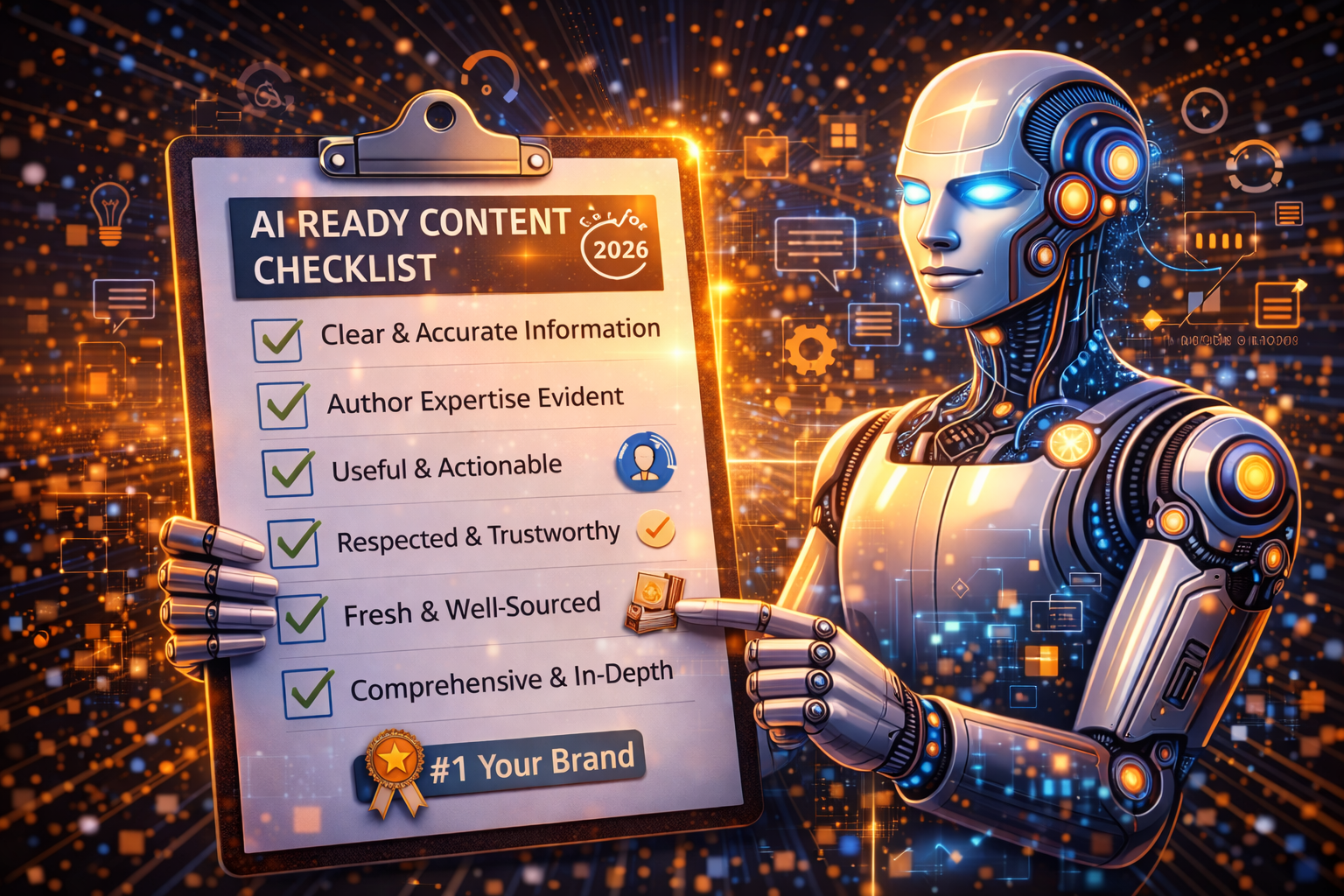
GEO & AI Visibility Spoke — built to be a definitive, cite-worthy resource for business owners who want their content selected, summarized, and referenced inside AI-generated answers.
Is my content AI-ready? A checklist for 2026.
Direct Answer: Your content is AI-ready when it answers one clear question per page, places a precise direct answer near the top, uses extraction-friendly structure, proves claims with steps and credible references, reinforces your brand as a consistent entity (with complete schema), stays technically clean (canonical, indexable, secure), and connects to a hub-and-spoke internal link system that clarifies topical relationships. Therefore, this checklist helps you audit pages fast, fix the highest-impact issues first, and increase your chances of being cited in AI answers while still converting human readers.
AI search changed the game. However, you do not need “AI tricks.” Instead, you need clarity, structure, and trust. Consequently, your best advantage is to publish content that is easy to retrieve, safe to cite, and simple to implement. That is exactly what this page delivers.
This spoke supports the hub: Generative Engine Optimization (GEO) & AI Visibility. Additionally, it connects with these sibling spokes: What is GEO and how is it different from traditional SEO?, How do I get my brand cited in Google’s AI Overviews?, How do I optimize my website for ChatGPT and Perplexity?, and What is Citation Share and why should I track it?.
Table of Contents
- What “AI-ready content” means in 2026
- How to use this checklist without overthinking it
- The AI-Ready Scorecard (quick audit)
- Checklist Pillar 1: Intent clarity and page scope
- Checklist Pillar 2: Extraction-ready structure
- Checklist Pillar 3: Trust, proof, and citation safety
- Checklist Pillar 4: Entity clarity and schema completeness
- Checklist Pillar 5: Technical readiness (indexing, canonicals, security)
- Checklist Pillar 6: Internal linking and topical architecture
- Checklist Pillar 7: UX and conversion clarity for humans
- Copy-and-paste templates: direct answers, steps, and checklists
- Common reasons AI systems ignore a page
- How to measure AI readiness with Citation Share
- Internal links to hubs and related resources
- External authority references
- FAQ
What “AI-ready content” means in 2026
Direct Answer: AI-ready content is content that AI systems can retrieve, understand, summarize, and cite accurately with low risk. Therefore, AI-ready content prioritizes clarity, structure, verification, and consistent entity signals over fluff, hype, and vague opinions.
In 2026, your content competes in two arenas at the same time. First, it competes for humans who want the quickest path to a correct decision. Meanwhile, it competes for AI systems that must choose which sources feel safe to reference. Therefore, your job is to reduce friction for both audiences.
AI systems do not reward “word count.” Instead, they reward answer quality. However, they often detect answer quality through signals you can control, such as: structured headings, definitions, steps, evidence, and consistent identity signals. Consequently, AI-ready content is less about writing style and more about design for extraction and trust.
How to use this checklist without overthinking it
Direct Answer: Use this checklist in three passes: (1) run the quick scorecard, (2) fix the highest-impact items first, and (3) re-check after updates using the same scoring method. Therefore, you create consistent improvement without chasing daily AI volatility.
Pass 1: Score the page in 10 minutes
Start with the scorecard below. Because you want momentum, you should not debate small details yet. Instead, you should identify the biggest blockers fast.
Pass 2: Fix the top 5 blockers
Most pages fail for the same reasons: unclear intent, buried answers, weak proof, messy entity signals, or technical duplication. Therefore, fix those first.
Pass 3: Improve once per month
AI answer surfaces fluctuate. However, stable gains come from stable improvements. Therefore, update your most important pages monthly and track Citation Share trends instead of single-day snapshots.
The AI-Ready Scorecard (quick audit)
Direct Answer: A page is “AI-ready” when it scores strong across intent clarity, extraction structure, proof and trust, entity clarity plus schema, technical readiness, and internal linking architecture. Therefore, use this scorecard to prioritize work and measure improvement.
Scoring rule: Give each item a 0, 1, or 2.
- 0 = missing or weak
- 1 = present but inconsistent
- 2 = strong and consistent
AI-Ready Scorecard (0–40)
- Intent clarity (0–6): One question, one page, no mixed goals.
- Extraction structure (0–8): Direct answer early, clear headings, lists, steps.
- Proof and trust (0–8): Steps, limitations, references, no hype.
- Entity and schema (0–6): Clear publisher, consistent contact info, full schema stack.
- Technical readiness (0–6): Indexable, canonical, secure, fast enough.
- Internal architecture (0–4): Hub + sibling links, descriptive anchors.
- Human UX clarity (0–2): Readable, scannable, actionable.
How to interpret your score
- 34–40: Strong AI-ready foundation. Therefore, focus on expanding coverage and improving proof packs.
- 26–33: Close. However, a few blockers likely prevent consistent citations.
- 18–25: Mixed readiness. Therefore, rebuild structure and tighten intent.
- 0–17: Not AI-ready. Consequently, treat it as a rewrite, not a tune-up.
Checklist Pillar 1: Intent clarity and page scope
Direct Answer: AI systems select sources faster when the page matches one intent cleanly. Therefore, AI-ready pages answer one primary question per URL and keep the scope disciplined.
Intent clarity checklist
- Does the page answer one primary question that matches the H1?
- Do you avoid mixing multiple buyer intents (definition + pricing + service pitch) on one page?
- Do your H2/H3 headings map to sub-questions of the same intent?
- Do you define terms early so meaning stays stable?
- Do you state boundaries (when this advice applies, and when it does not)?
Scope boundary examples (use these)
- “This checklist applies to informational and how-to pages designed to earn citations.”
- “If your page is a product page or a checkout page, use a different audit.”
- “If your goal is local service leads, apply the same structure but adapt proof packs to local trust signals.”
Therefore, you reduce confusion and improve matching. Additionally, you protect the page from becoming a “kitchen sink” that AI systems summarize poorly.
Checklist Pillar 2: Extraction-ready structure
Direct Answer: Extraction-ready structure increases AI citations because it makes your best answer easy to find, easy to quote, and hard to misunderstand. Therefore, you should design the page like a reference document, not a blog rant.
Extraction structure checklist
- Do you include a Direct Answer block near the top?
- Do you use a Table of Contents with clear section labels?
- Do you write short paragraphs with clear topic sentences?
- Do you use lists, steps, and decision rules for complex topics?
- Do you use consistent heading patterns (H2 for sections, H3 for sub-questions)?
Direct answer rules
- Keep it 1–3 sentences.
- Use plain language.
- State the “how” and the “why” quickly.
- Avoid hype words that reduce trust.
Make “quotable passages” on purpose
AI systems often extract small passages. Therefore, you should create passages that stand alone:
- Define the term in one sentence.
- Explain why it matters in one sentence.
- Give the first actionable step in one sentence.
Consequently, your page becomes easy to cite accurately.
Checklist Pillar 3: Trust, proof, and citation safety
Direct Answer: AI systems avoid risky sources. Therefore, AI-ready content must prove key claims with steps, constraints, and credible references, while also avoiding “guarantee language” that triggers skepticism.
Proof pack checklist
- Do you include step-by-step instructions people can follow?
- Do you include decision criteria, not only opinions?
- Do you include limitations (what can break the tactic)?
- Do you reference authoritative documentation when it strengthens trust?
- Do you avoid unrealistic promises and vague superlatives?
Use “risk-lowering language” that still sounds confident
- Replace “guarantee” with “increase the likelihood.”
- Replace “always” with “in most cases.”
- Replace “secret trick” with “repeatable process.”
Add verification hooks
Verification hooks help both humans and AI systems trust the advice. Therefore, include checks like:
- “If you see X in Search Console, do Y.”
- “If the canonical points to a different URL, fix that first.”
- “If your page has multiple intents, split it into spokes.”
Consequently, your content reads like a diagnostic guide, which tends to earn citations more consistently.
Checklist Pillar 4: Entity clarity and schema completeness
Direct Answer: Entity clarity increases AI citation consistency because it reduces uncertainty about who published the content and why it is credible. Therefore, AI-ready pages reinforce publisher identity and include a full schema stack.
Entity clarity checklist
- Is your organization name consistent across the site?
- Is your phone, email, and address consistent everywhere?
- Do you clearly present the publisher as the expert source?
- Do you maintain a clean, complete schema stack on every page?
Schema stack checklist (minimum required for AI-ready spokes)
- Organization
- WebSite
- ProfessionalService
- WebPage
- Article
- FAQPage
- HowTo (when the page includes steps)
- BreadcrumbList
- SpeakableSpecification
Therefore, your page becomes easier to interpret, easier to categorize, and safer to cite.
Checklist Pillar 5: Technical readiness (indexing, canonicals, security)
Direct Answer: Technical readiness is AI readiness because AI systems still depend on clean crawl, index, and canonical signals. Therefore, you must keep each citation target indexable, canonicalized, and secure.
Technical readiness checklist
- Is the page indexable (no accidental noindex)?
- Does the page have one correct canonical URL?
- Do internal links point to the canonical version?
- Do you avoid parameter duplicates and thin tag pages competing?
- Does the page load reliably on mobile?
- Does the site stay secure (HTTPS, no spam injection, clean scripts)?
Because technical issues can silently break AI retrieval, you should treat technical hygiene as a first-class GEO input, not a “later” task.
Checklist Pillar 6: Internal linking and topical architecture
Direct Answer: Hub-and-spoke internal linking improves AI understanding because it clarifies hierarchy and relationships. Therefore, every spoke should link to the hub, and relevant spokes should link to each other using descriptive anchors.
Internal architecture checklist
- Does the spoke link back to its hub near the top and again near the bottom?
- Does the spoke link to 2–6 relevant sibling spokes?
- Do anchors describe the topic (not “click here”)?
- Does the hub link out to all spokes in a structured map?
Consequently, you teach both crawlers and humans how your knowledge base is organized. Additionally, you reduce topical drift because each page has a clear role.
Checklist Pillar 7: UX and conversion clarity for humans
Direct Answer: AI-ready pages still need human-ready UX. Therefore, you should design for skimming, quick wins, and clarity, while staying educational instead of sales-heavy.
Human UX checklist
- Do you use short sentences and short paragraphs?
- Do you provide actionable steps, not only explanations?
- Do you avoid jargon unless you define it immediately?
- Do you include checklists and examples people can apply today?
Therefore, your content earns trust and engagement, which also tends to reinforce authority signals over time.
Copy-and-paste templates: direct answers, steps, and checklists
Direct Answer: Templates keep your content consistent, which improves extraction and trust. Therefore, use these repeatable blocks across hubs and spokes.
Template 1: Direct Answer block
Direct Answer: [Answer the question in 1–3 sentences. State what to do, why it matters, and the first step to start.]
Template 2: “Why it matters” block
- Why it matters: [Explain the business impact.]
- What breaks it: [Name the top failure modes.]
- What to do next: [Give the first action.]
Template 3: Step-by-step HowTo block
- Step 1: [Define the goal and the success condition.]
- Step 2: [Do the setup work that prevents false results.]
- Step 3: [Implement the tactic.]
- Step 4: [Verify it with a test.]
- Step 5: [Measure and iterate monthly.]
Template 4: “AI-ready checklist” block
- Intent: one question, one page, one promise.
- Structure: direct answer early, headings match sub-questions.
- Proof: steps, limitations, references, no hype.
- Entity: consistent publisher signals + full schema.
- Technical: indexable, canonical, secure, mobile reliable.
- Links: hub + siblings, descriptive anchors.
Consequently, you can scale content production while keeping quality consistent.
Common reasons AI systems ignore a page
Direct Answer: AI systems ignore pages when intent is unclear, answers are buried, proof is weak, identity signals are inconsistent, or technical issues create duplicate or unreliable retrieval targets. Therefore, fix those first.
Failure mode 1: The page tries to do everything
Mixed intent creates mixed signals. Therefore, split pricing, definitions, and how-to guidance into separate spokes and connect them through a hub.
Failure mode 2: The answer is hidden behind storytelling
Stories can help humans. However, AI extraction often prefers the answer first. Therefore, lead with the answer, then add context.
Failure mode 3: Claims sound like marketing
Marketing language increases risk. Therefore, use precise steps, constraints, and references instead of hype.
Failure mode 4: The site sends inconsistent identity signals
If entity signals conflict, trust drops. Therefore, keep your organization data consistent and reinforce it with schema.
Failure mode 5: Canonical confusion fragments citations
If multiple URL versions exist, citations can split. Therefore, clean up canonicals and internal links.
How to measure AI readiness with Citation Share
Direct Answer: Measure AI readiness by tracking Citation Share across a defined question set, then improving the pages that fail to earn citations consistently. Therefore, your optimization becomes measurable and repeatable.
If you want a full measurement framework, read: What is Citation Share and why should I track it?. Additionally, if you want an execution roadmap for assistants, read: How do I optimize my website for ChatGPT and Perplexity?.
Minimum viable measurement loop
- Pick 50–200 questions your buyers ask.
- Map each question to one “best answer” URL.
- Check monthly whether your domain is cited for each question.
- Fix the weakest pages using this checklist.
- Repeat until Citation Share rises across your highest-value intents.
Therefore, you stop guessing and start improving what the market actually rewards.
Internal links to hubs and related resources
- Hub: Generative Engine Optimization (GEO) & AI Visibility
- Spoke: What is GEO and how is it different from traditional SEO?
- Spoke: How do I get my brand cited in Google’s AI Overviews?
- Spoke: How do I optimize my website for ChatGPT and Perplexity?
- Spoke: What is Citation Share and why should I track it?
- Resource: The Ultimate Guide to GEO
- Resource: GEO vs SEO: Beyond the Blue Link
- FAQ: Generative Engine Optimization Answers
- Technical: XML Sitemaps and Robots.txt Best Practices
- Architecture: The Role of Internal Linking in a 1,000-Page Strategy
External authority references
- Google Search Central: AI features and your website
- Google Search Help: AI Overviews
- Google Search Central: Structured data basics
- Schema.org: Structured data vocabulary
- Schema.org: SpeakableSpecification
- Web.dev: SEO learning resources
- OpenAI Help Center: ChatGPT search and sources
FAQ
Do I need to write longer pages to be AI-ready?
No. However, you need complete coverage for the intent. Therefore, write as long as needed to be the best answer, and then stop. If the topic is complex, you can still keep sections concise by using steps and checklists.
Does schema guarantee citations?
No. However, schema reduces ambiguity about your entity and page purpose. Therefore, schema increases the chance that systems interpret you correctly when paired with strong structure and proof packs.
Can AI-ready content still convert leads?
Yes. In fact, clear educational pages often convert better because they build trust. Therefore, keep the page informational, and then guide readers to the next best resource through internal links.
How often should I update AI-ready pages?
Monthly is a strong default. Therefore, refresh your top hubs and spokes monthly, while monitoring Citation Share trends instead of daily volatility.