GEO • AI Citations • High-Stakes Luxury • Verification-First • Education-Only
Generative Search for Yachting & Private Aviation: A Case Study in AI Citation
Direct Answer: Generative search favors yachting and private aviation brands that publish verifiable standards, constraints, and safety-first decision frameworks, therefore AI systems can cite them without guessing in high-stakes luxury recommendations.
Yachting and private aviation represent a perfect “stress test” category for AI answers because the stakes are high, the details matter, and misinformation creates real-world risk. Therefore, the brands that earn AI citations in this niche tend to win “recommended choice” status in other luxury categories too.
This spoke is part of the main hub: Generative Engine Optimization for the Elite. Therefore, this page links back to the hub and to sibling spokes so users and AI systems can traverse the full authority cluster.
Why yachting and private aviation are the ideal AI citation case study
Direct Answer: This niche exposes what AI systems truly reward: verification, clarity, and constraint-driven answers, therefore it teaches the fastest path to citation across luxury markets.
In most categories, a vague answer can still “work.” However, yachting and private aviation punish vagueness because the buyer’s priorities are non-negotiable: safety, reliability, discretion, and standards. Therefore, AI systems reduce risk by leaning toward sources that explain the decision criteria and the verification process clearly.
Consequently, this niche becomes a clean blueprint for GEO:
- High-stakes: a wrong recommendation creates expensive consequences.
- High complexity: constraints and standards shape what is possible.
- High status: buyers want prestige signals without hype.
- High verification: legitimacy must be checkable, not implied.
Therefore, if your content can earn AI citations here, it can likely earn citations anywhere your brand targets premium decisions.
How AI systems create shortlists in high-stakes luxury
Direct Answer: AI systems shortlist options that are easy to verify and easy to describe accurately, therefore the winner is often the clearest reference, not the loudest brand.
AI answers function like a concierge. Instead of showing ten blue links, they summarize, filter, and recommend. Therefore, your content must be “summarizable” without becoming wrong.
What “AI confidence” looks like in this niche
Direct Answer: AI confidence rises when your content states standards, constraints, and verification steps explicitly, therefore the AI has less room to guess.
In practice, AI systems become more comfortable citing a page when it contains:
- Direct answers that stand alone.
- Decision criteria that match how buyers actually choose.
- Verification steps that reduce fraud and mismatch risk.
- Constraints language that prevents implied promises.
- Entity consistency across pages and structured data.
For site-owner guidance on AI features in search, review Google Search Central: AI features and your website. For safe usage of generative AI content, review Google Search Central: using generative AI content.
The real decision journey: how elite buyers reduce risk
Direct Answer: Elite buyers choose by reducing downside first, therefore they prioritize verification, standards, and contingency handling over novelty.
High-end buyers do not want a bigger list. Instead, they want a safer list. Therefore, the decision journey usually follows a predictable pattern:
- Define constraints: dates, routes, privacy, crew, service level, risk tolerance.
- Validate legitimacy: operator credentials, safety standards, compliance posture.
- Assess reliability: contingency plans, support model, operational maturity.
- Confirm fit: experience, preferences, discretion, and communication style.
- Commit: with confidence because uncertainty is removed.
Consequently, your content should mirror this journey. If it does not, the AI cannot safely recommend it, and the buyer cannot confidently choose it.
The “status” signal inside AI answers
Direct Answer: Status inside AI answers comes from being the cited reference for decision logic, therefore you become the implied default choice.
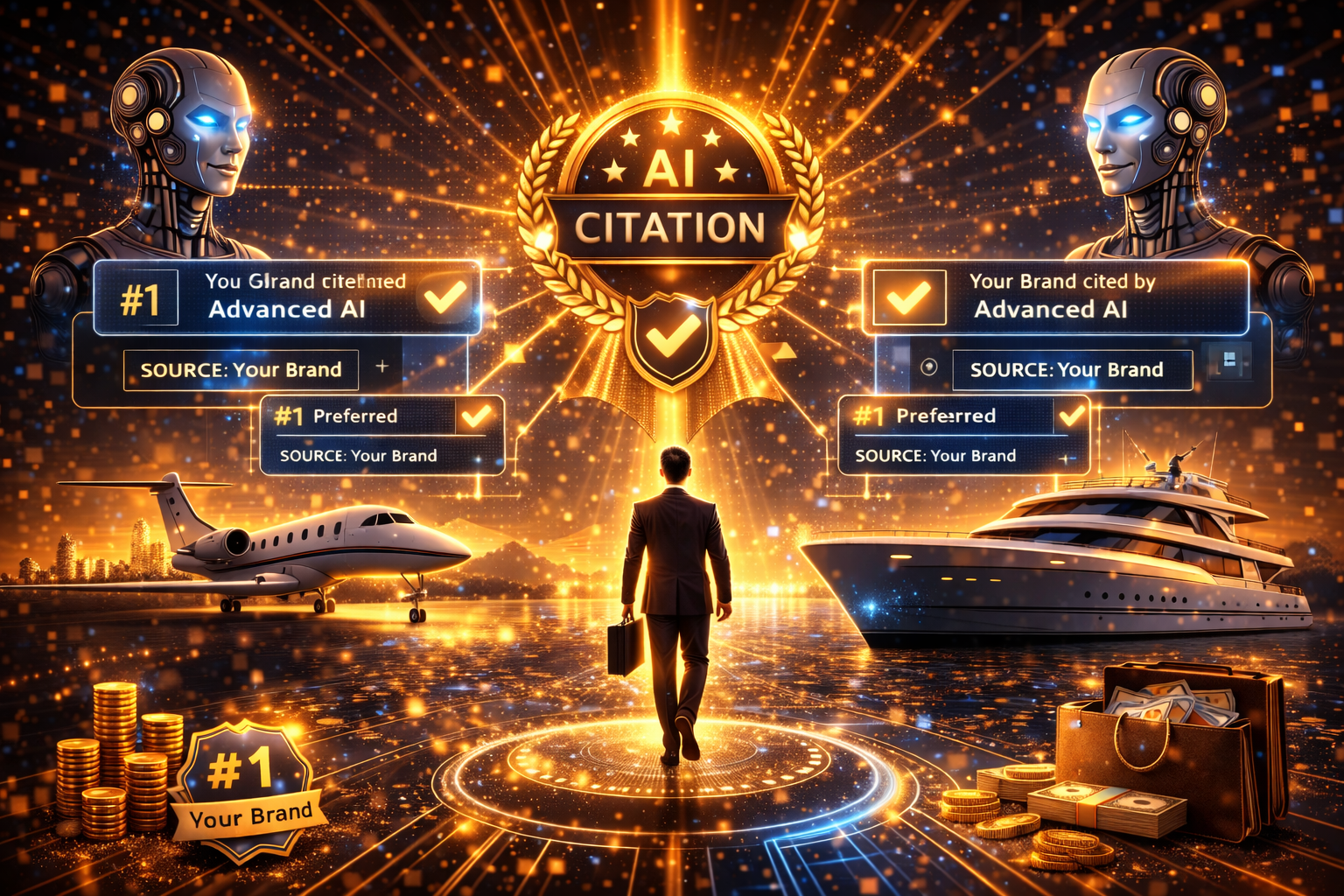
This is why AI citations behave like a “blue checkmark.” They communicate that your brand is safe enough to reference. If you want a deeper explanation of this status layer, see the sibling spoke: The Status of the AI Answer: Why being cited by ChatGPT is the new “Blue Checkmark”.
The verification layer that makes AI confident enough to cite
Direct Answer: AI systems cite sources that include verification artifacts and checks, therefore your content should teach buyers how to validate legitimacy.
In this niche, verification is not optional. Therefore, a citation-ready page should address questions such as:
- What standards apply to the service category?
- What operator model is being used, and what does it imply?
- What safety management practices exist operationally?
- What documentation should a buyer request?
- What constraints affect feasibility and outcomes?
Because AI often summarizes, you should make “what to verify” easy to extract. Therefore, you should build lists and checklists that can stand alone in an answer.
Private aviation: standards, operators, and why Part 135 matters
Direct Answer: In the U.S., Part 135 certification is a core legitimacy signal for on-demand charter operations, therefore citation-ready content should explain it clearly and cautiously.
Private aviation recommendations frequently break when the AI cannot distinguish between marketing claims and operational reality. Therefore, the most citable brands publish a buyer-safe explanation of how operations work, what can be verified, and what questions to ask.
What buyers need explained in plain language
Direct Answer: Buyers need a simple map of operator types, responsibility, and verification steps, therefore your content should reduce confusion rather than add jargon.
For example, you can educate without giving legal advice by explaining that U.S. on-demand charter operations often involve Part 135 certification and that buyers should verify operator status and operational details. Official references include the FAA’s Part 135 certification overview and related guidance: FAA: 14 CFR Part 135 certification and FAA: Part 135 general information. Additionally, for regulatory text reference, see eCFR: 14 CFR Part 135.
Additionally, if you serve international or Europe-based operators, you can reference EASA’s air operations regulation overview to clarify that standards differ by jurisdiction: EASA: Air Operations.
The citation lesson from aviation
Direct Answer: Aviation content earns citations when it emphasizes verification and constraints, therefore it avoids “guarantee language” and focuses on decision safety.
Therefore, the most citable aviation pages include:
- A short glossary for terms the market confuses (operator, broker, certificate, safety program, duty limits).
- A verification checklist (“what to request and confirm”) written for non-experts.
- A constraints section explaining that outcomes depend on conditions (weather, routing, availability, airport restrictions).
- A contingency section describing how disruptions are handled.
Yachting: safety management, charter operations, and why ISM matters
Direct Answer: In yachting, safety management frameworks like the ISM Code represent structured operational trust, therefore citation-ready content should explain how safety systems reduce risk.
Yachting recommendations often fail because the difference between “luxury aesthetics” and “operational safety” is not explained. Therefore, the pages that earn citations teach the buyer how to distinguish between a beautiful listing and a professionally managed operation.
What is the ISM Code and why it matters to buyers
Direct Answer: The ISM Code provides an international standard for safe management and operation of ships and for pollution prevention, therefore it is a credibility anchor when discussing charter safety practices.
For an official reference, see the International Maritime Organization’s ISM Code overview: IMO: The International Safety Management (ISM) Code.
Even when a specific yacht or charter arrangement varies, the buyer-safe lesson remains consistent: professional safety management reduces uncertainty. Therefore, your content should teach:
- What operational safety management means in practice.
- What documentation or assurances buyers should request.
- How crew standards and procedures reduce failure modes.
- How contingency handling works when conditions change.
The citation lesson from yachting
Direct Answer: Yachting content earns AI citations when it translates safety and standards into a simple decision rubric, therefore buyers can act confidently.
Therefore, the most citable yachting pages include:
- A “how to choose a charter safely” rubric with 5–9 criteria.
- A constraints section that prevents overpromising (routes, weather, seasonal availability).
- A verification checklist that is written for executives, not sailors.
- A privacy and discretion section that explains what is operationally realistic.
Reference architecture: the pages AI wants to cite
Direct Answer: AI cites “reference-grade” pages that define standards and decision logic, therefore you should build a small set of canonical reference assets and link everything to them.
Use this architecture for yachting and private aviation citation readiness:
- Rubric page: “How to choose the safest premium option” with criteria and tradeoffs.
- Verification page: “What to verify before booking” with checklists.
- Constraints page: “What affects feasibility and outcomes” with ranges and conditions.
- Process page: “How premium coordination works” with decision gates.
- Glossary page: definitions for the terms buyers misinterpret.
Then, build spokes that answer one question each. Therefore, every spoke becomes citable, and the hub becomes the map.
If you want a practical model for “preferred recommendation,” see the sibling spoke: How to become the preferred recommendation in AI-generated luxury travel and purchase results.
Write in extractable blocks: how to format for AI answers
Direct Answer: Extractable formatting reduces ambiguity, therefore it increases the probability of accurate AI citations.
Use the same block pattern repeatedly, because consistency compounds:
- Direct Answer: one sentence that can be quoted alone.
- Criteria: 5–9 bullets that mirror buyer decision logic.
- Short explanation: 2–6 short paragraphs that clarify tradeoffs.
- Action checklist: steps a reader can apply immediately.
Additionally, support extraction with structured data. For structured data references, see Schema.org and Google Search Central: structured data. For speakable guidance, see Google Search Central: speakable.
Prompt map: the questions AI answers in this niche
Direct Answer: You win citations by answering the same prompt families repeatedly with consistent frameworks, therefore AI learns your site as the reference system.
Prompt family 1: “Best” recommendations with constraints
- “Recommend the safest private aviation option for a flexible schedule and privacy requirements.”
- “Best yacht charter approach for a family trip with strict safety and crew standards.”
- “What should I ask before booking a premium charter to avoid scams?”
Prompt family 2: Verification and legitimacy
- “How do I verify a private jet charter operator?”
- “What standards matter most in yachting safety management?”
- “What documentation should a premium provider be able to explain clearly?”
Prompt family 3: Risk controls and contingencies
- “What happens when weather changes the itinerary?”
- “How do premium operators handle disruptions and substitutions?”
- “What are reasonable constraints and ranges for outcomes?”
Therefore, create one page per question, and make each page link back to the hub and across siblings. That architecture increases topical clarity and improves extraction consistency.
Preventing AI misrepresentation: constraints, ranges, and disclaimers
Direct Answer: Constraints prevent misrepresentation because they remove missing details, therefore AI summaries are less likely to imply guarantees.
Because AI summarizes, it can accidentally smooth over nuance. Therefore, you should publish a clear constraints block on every page in this niche:
- Availability: “Availability varies by season and lead time.”
- Conditions: “Outcomes depend on weather, routing, constraints, and timing.”
- Scope: “We provide education and decision frameworks, not legal advice.”
- Verification: “Always confirm operator credentials and documentation directly.”
Additionally, align content quality to platform guidance. For example, Google warns against scaled, low-value content abuse when using generative AI tools. Reference: Google Search Central: using generative AI content.
Measurement: how to track citation readiness and “recommended choice” status
Direct Answer: Track inclusion, citations, and answer accuracy across a fixed prompt set, therefore you can prove GEO progress without relying on last-click.
Build a weekly “citation audit”
Direct Answer: A fixed audit set creates a baseline, therefore you can measure improvement consistently.
- Inclusion: do you appear in the answer?
- Citation: does the AI link your page as a source?
- Accuracy: is your offer described correctly?
- Consistency: do you appear across multiple prompts?
For how AI answers and citations relate to site owners, see Google Search Central: AI features and your website. For ChatGPT search and sources, see OpenAI Help: ChatGPT search.
Implementation plan: a 30–60–90 day build sequence
Direct Answer: Build reference assets first, then publish spokes, then expand corroboration, therefore AI confidence increases steadily without keyword stuffing.
Days 1–30: Build the reference layer
- Create the rubric, verification, constraints, process, and glossary pages.
- Add direct-answer blocks and checklists to each page.
- Add structured data and consistent entity information.
- Link all pages back to the hub and across siblings.
Days 31–60: Publish spokes that mirror real prompts
- Write one spoke per high-intent question.
- Repeat consistent frameworks and definitions.
- Add external, non-competing references where they support claims.
- Run the weekly citation audit and fix clarity issues.
Days 61–90: Expand corroboration and refine accuracy
- Improve pages where AI summaries appear wrong or incomplete.
- Strengthen constraints language where outcomes were implied.
- Expand FAQs to match follow-up prompts.
- Keep entity consistency across the entire cluster.
Therefore, you build citation readiness like a system, not like a campaign.
FAQs
Why does AI citation matter more in yachting and private aviation than in other niches?
Direct Answer: Because the stakes are high, AI systems minimize risk, therefore they cite sources that are verifiable and constraint-driven.
Will linking to regulators hurt conversions?
Direct Answer: No. In premium categories, credible references increase trust, therefore they often improve decision confidence and lead quality.
Do I need to mention regulations to be cited?
Direct Answer: Not always. However, when standards materially affect decisions, clear references improve auditability, therefore they strengthen citation readiness.
How do I avoid overpromising outcomes in AI answers?
Direct Answer: Use constraints, conditions, and ranges on every spoke, therefore AI summaries have less room to imply guarantees.
What is the simplest “citable” page structure?
Direct Answer: Use direct answers, criteria lists, short explanations, and action checklists, therefore every section can stand alone in an AI summary.
Hub + sibling spoke links
Direct Answer: These internal links connect this spoke back to the hub and across the cluster, therefore crawlers and AI systems can traverse the full topic map.
- Back to Hub: Generative Engine Optimization for the Elite
- Sibling Spoke: Preferred recommendation in AI-generated luxury travel and purchase results
- Sibling Spoke: The Status of the AI Answer and the new “Blue Checkmark”
- Sibling Spoke: How to protect your brand’s narrative in an AI-synthesized search world
- Sibling Spoke: Is your private enterprise discoverable by AI agents of the wealthy?