Case Study
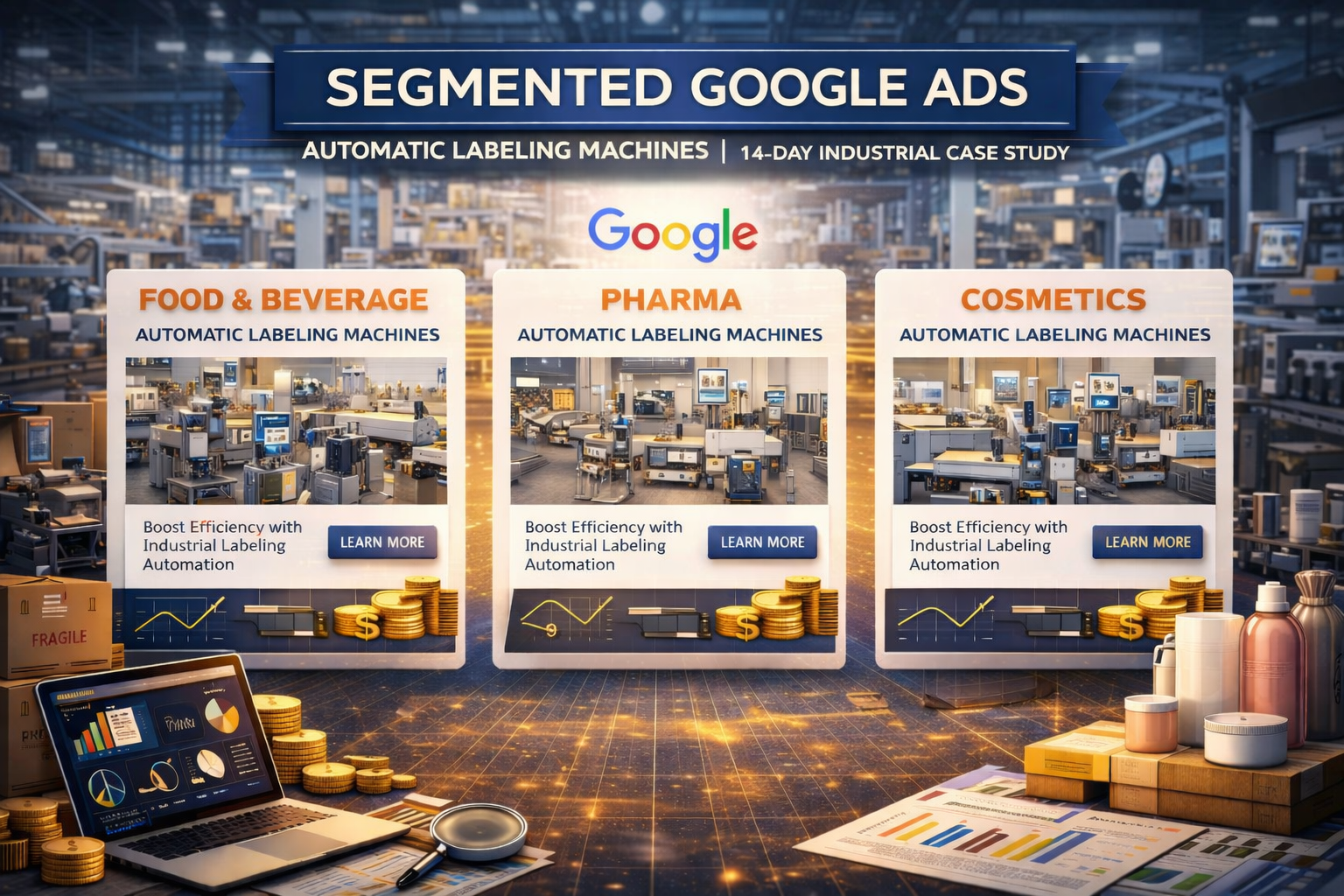
Segmented Google Ads For Automatic Labeling Machines
IMR built a nationwide, vertically segmented Google Ads system for automatic labeling machines supported by hub-and-spoke SEO pages that generated 77 tracked form fills this month and 85 tracked form fills last month.
Industrial marketing demands precision because buyers compare compliance requirements, throughput needs, and integration constraints before they ever contact a vendor. Therefore, we structured campaigns by vertical intent, aligned every ad group to a dedicated category page, and used extensions to guide visitors into the correct machine pathway.
We ran Google Search campaigns for high-intent capture, then we layered Performance Max for scaled reach, and we added video for awareness and remarketing depth. Additionally, we supported paid traffic with monthly hub-and-spoke pages that matched the same keyword themes. As a result, the account operated as one connected system rather than disconnected campaigns.
This case study stays truth-first. We report clicks, CTR, CPC, spend, and tracked form fills as observed. However, we do not claim closed revenue or conversion-to-customer outcomes because the available data does not verify that layer yet. Instead, we explain the measurement approach, the validation steps, and the next controls that improve qualified inquiry accuracy.
Table Of Contents
Case Study Snapshot
- Industry: Industrial automatic labeling machines (food, beverage, pharmaceutical, and general manufacturing applications)
- Market/Location: Nationwide United States
- Primary Goal: Increase purchase-intent inquiries through website form fills while maintaining scalable acquisition efficiency
- Conversion Outcome Tracked: Website form fills (tracked in the client’s reporting stack)
- Observed Form Fills: 77 this month; 85 last month
- Reported Spend Context: Approximately $2,500 total spend in the same recent campaign reporting window discussed below
- Campaign Types: Search, Performance Max, Video
- Landing Pages: Separate verticalized pages for Food & Beverage, Pharmaceutical, and General Automatic Labeling
- SEO Support: Ongoing hub-and-spoke content strategy aligned with paid keyword themes
- Known Limitation: A portion of form submissions may include non-buyer intent (for example, hiring inquiries) without separate conversion labeling
Because industrial buyers often require multiple touches, we designed the system to capture demand at the moment of intent, then to maintain visibility through scaled placements, and then to reinforce trust through pages that answered industry-specific questions. Consequently, the system supports both immediate inquiry capture and longer-cycle consideration.
The Challenge
Direct Answer: We needed to generate nationwide inbound demand for high-ticket automatic labeling machines while keeping message-match tight across verticals and maintaining measurement clarity even when some form submissions include mixed intent.
Automatic labeling buyers do not behave like consumer ecommerce buyers. Instead, they compare capabilities such as speed, label types, container formats, washdown needs, validation requirements, and integration with upstream and downstream equipment. Therefore, one generic campaign cannot speak clearly to everyone, and it cannot route traffic to the right page experience.
Additionally, food and beverage labeling carries operational constraints that differ from pharmaceutical labeling. For example, buyers use different terminology, different compliance language, and different validation concerns. As a result, industry segmentation improves relevance and reduces wasted clicks because the ad answers the real query rather than a vague promise.
Finally, the business can receive hiring-related submissions through website forms. That reality creates a measurement challenge when conversions are not split into buyer versus careers actions. Therefore, we treated reported form fills as “tracked submissions” and documented a clear plan to separate intent in the next phase.
Strategy (What We Did And Why)
1) Build Vertical Search Campaigns For High-Intent Capture
We created separate Google Search campaigns for primary industry segments. Therefore, we controlled keyword themes, ad language, and landing page routing for each intent lane. Additionally, we used large sitelink sets to expose deeper page pathways, which helped buyers self-select faster.
We observed the following Search performance in the same recent reporting window discussed for paid campaigns:
- Food & Beverage labeling: 926 clicks at $0.70 CPC with 6.02% CTR
- Pharmaceutical labeling: 544 clicks at $0.50 CPC with 3.2% CTR
- General automatic labeling: 308 clicks at $1.05 CPC with 6.18% CTR
CTR indicates message-match. However, CTR does not prove revenue. Therefore, we treat these numbers as evidence of relevance and engagement rather than proof of downstream profit.
2) Use Performance Max For Scale Without Confusing It With Search
We added Performance Max to expand reach across Google’s inventory. Because Performance Max distributes across multiple surfaces, it often drives a lower CPC than Search. Therefore, we separated reporting by campaign type so analysis stayed honest.
We observed two Performance Max campaigns in the same recent reporting window discussed for paid campaigns:
- PMax Campaign 1: 9.98K clicks, 0.83% CTR, $0.05 CPC
- PMax Campaign 2: 10.1K clicks, 0.63% CTR, $0.04 CPC
These numbers show scale. However, they do not automatically represent high-intent purchase traffic. Therefore, we treat Performance Max as a scaled exposure layer that supports assisted conversions, remarketing depth, and repeated brand contact.
3) Add Video To Increase Familiarity In A Long Sales Cycle
We deployed a video campaign with five videos. Video supports industrial sales cycles because buyers require education, proof, and repeated exposure before they reach out. Therefore, we used video as a demand-building layer rather than a direct-response replacement.
- Views: 15.3K
- View rate: 35.83%
- CPV: $0.01
- Clicks: 54
We used video to build familiarity and to expand remarketing pools. Consequently, Search and PMax benefit from a warmer audience over time.
4) Align Ads, Sitelinks, And Pages With A Monthly Hub-And-Spoke Plan
We built separate pages for each category. Additionally, we publish monthly hub-and-spoke pages tailored to keyword clusters. Because those pages strengthen topical coverage and clarify entities, they support both paid relevance and organic growth. Therefore, the system compounds rather than resets every month.
We also used extensive sitelinks to route buyers to specific machine categories and supporting content. As a result, the ads functioned like a guided navigation menu, which improved clarity and reduced mismatch clicks.
Implementation (Step-By-Step)
Because the process matters as much as the metrics, we document the implementation as a reusable playbook. Additionally, this section supports HowTo schema.
- Define vertical intent lanes.
We separated Food & Beverage, Pharmaceutical, and General intent so each lane used accurate terminology and routed to the correct page.
- Build one dedicated page per lane.
We routed each lane to a dedicated page to improve message-match and reduce mismatch clicks.
- Create tightly themed keyword groupings.
We grouped keywords by machine intent and application terms, then we aligned ad copy to the same theme for clarity.
- Deploy sitelinks as guided navigation.
We used extensive sitelinks to guide self-selection and increase ad clarity for multiple machine categories.
- Enable controlled search asset variation.
We used AI-assisted search assets where appropriate while maintaining factual, controlled messaging.
- Launch Performance Max as a separate layer.
We deployed Performance Max for scaled reach and evaluated it separately from Search to keep analysis honest.
- Add a multi-creative video campaign.
We used multiple videos to build familiarity and remarketing depth for long industrial buying cycles.
- Track form fills and label intent limits.
We tracked monthly form fills while acknowledging mixed intent when hiring inquiries appear.
- Improve conversion hygiene next.
We planned separate careers and sales conversion actions, plus job-intent negatives and routing controls.
Decision Rules We Used
- If the query shows vertical specificity, then route to the matching vertical page rather than a general page.
- If the traffic source distributes broadly, then evaluate it as awareness or assisted influence rather than direct purchase intent.
- If form submissions include mixed intent, then split conversion actions before claiming qualified lead results.
- If CTR rises while qualified inquiries fall, then tighten landing page alignment and add intent gating instead of chasing cheaper clicks.
Measurement & Validation
Truth-first case studies require clear boundaries. Therefore, we separate observed facts, methods used, and inferences.
Observed Facts (Provided/Measured)
- Monthly form fills: 77 this month; 85 last month.
- Search performance (recent reporting window): 926 clicks at 6.02% CTR and $0.70 CPC (Food & Beverage), 544 clicks at 3.2% CTR and $0.50 CPC (Pharma), 308 clicks at 6.18% CTR and $1.05 CPC (General).
- PMax performance (recent reporting window): 9.98K clicks at 0.83% CTR and $0.05 CPC, plus 10.1K clicks at 0.63% CTR and $0.04 CPC.
- Video performance (recent reporting window): 15.3K views, 35.83% view rate, $0.01 CPV, 54 clicks.
- Spend context: Approximately $2,500 for the same recent paid campaign reporting window described above.
- Landing page approach: Separate pages by category with extensive sitelinks and supporting monthly hub-and-spoke pages.
- CRM context: HubSpot source reporting in the last 30 days shows contacts distributed across Direct Traffic, Organic Search, Paid Search, Referrals, AI Referrals, and Offline Sources.
Methods Used (IMR Process)
- We segmented campaign structure by industry intent and landing page alignment.
- We expanded ad surface coverage through PMax and video while keeping Search lanes clean.
- We used sitelinks and page architecture to reduce friction and clarify buyer paths.
- We maintained monthly hub-and-spoke publishing to support topical coverage and keyword alignment.
Inferences / Hypotheses (Clearly Labeled)
- Inference: Vertical pages likely improved engagement because Search CTR stayed strong where message-match remained tight.
- Inference: PMax and video likely supported assisted conversions by increasing familiarity and remarketing pool depth.
- Inference: Hub-and-spoke publishing likely improved overall contact diversity by supporting organic and direct pathways alongside paid search.
Attribution Limits
Industrial buyers research across multiple sessions. Therefore, last-click attribution undercounts earlier touches. Additionally, PMax and video often influence behavior without receiving direct credit. As a result, we treat the “recent paid campaign window” as an acquisition snapshot, while we treat the monthly form fill totals as the tracked conversion activity across each month.
What We Can Prove
- We can prove paid campaign performance metrics (clicks, CTR, CPC) as reported for the recent paid campaign window.
- We can prove monthly tracked form fills: 77 this month and 85 last month.
- We can prove the architecture: segmented Search, layered PMax, video support, and vertical landing pages plus monthly hub-and-spoke publishing.
What We Cannot Claim
- We cannot claim closed revenue, ROAS, or profit impact without verified pipeline outcomes.
- We cannot claim that all monthly form fills represent buyers because some submissions may include hiring inquiries without split conversion tracking.
- We cannot claim a universal benchmark outcome because competition, geography, and offer clarity vary.
Results (Truth-First)
Monthly Form Fills (Tracked)
- This month: 77 form fills
- Last month: 85 form fills
These totals show consistent inquiry flow month over month. However, we do not label them as “qualified sales leads” because the reporting does not yet split buyer intent from hiring intent. Therefore, we treat these totals as tracked submissions.
Paid Campaign Performance (Recent Reporting Window)
Within the same recent paid campaign reporting window, Search delivered strong engagement in two vertical lanes with CTR above 6%, which indicates high relevance and strong message-match. Additionally, Performance Max scaled click volume aggressively at very low CPC. However, PMax includes broader placements. Therefore, we evaluate that layer as reach and assisted influence rather than pure direct-response intent.
Quality Improvement Roadmap (Because Mixed Intent Exists)
Mixed-intent form fills do not represent failure. Instead, they reveal a routing opportunity. Therefore, the next phase focuses on conversion hygiene:
- Create a dedicated careers path and a dedicated sales inquiry path, then route users intentionally.
- Add job-intent negatives where appropriate (for example: jobs, careers, hiring, salary, resume, internship).
- Add a short intent gate on the form (for example: “Are you requesting equipment pricing or production guidance?”), then track that answer.
- Split conversion actions into “Sales Form Submit” and “Careers Submit,” then optimize bidding toward sales intent.
These steps improve clarity. Additionally, they enable future reporting on cost per qualified inquiry without guesswork.
SEO & GEO Integration Layer
Paid search performs better when pages match intent, answer the question fully, and provide clear next steps. Therefore, we built category pages that aligned to the same keyword themes used in Search campaigns.
We also publish monthly hub-and-spoke pages tailored to keyword clusters. That approach increases topical coverage, improves internal link clarity, and strengthens entity understanding. As a result, the site supports both SEO and AI answer systems while also improving landing page relevance for paid traffic.
HubSpot source reporting in the broader 30-day view reinforces the multi-channel reality: contacts came from Direct Traffic, Organic Search, Paid Search, Referrals, AI Referrals, and Offline Sources. Therefore, the account does not rely on a single channel, and the system can compound as content grows.
Lessons & Reusable Framework
Industrial acquisition rewards systems, not hacks. Therefore, we summarize the framework as a reusable checklist with decision rules.
Reusable Checklist: Industrial Google Ads System For High-Ticket Equipment
- Segment Search by vertical intent, then align each lane to a dedicated page.
- Use sitelinks to guide self-selection and reduce mismatch clicks.
- Separate Search reporting from PMax reporting so analysis stays honest.
- Use video to build familiarity and remarketing pools, especially when sales cycles run long.
- Publish hub-and-spoke pages monthly so topical authority and relevance compound.
- Track conversions truthfully, then split mixed intent before claiming qualified outcomes.
If/Then Decision Rules
- If a vertical shows high CTR, then expand coverage and deepen the page with more application-specific content.
- If PMax drives scale but lower intent, then tighten signals and route traffic to clearer pages instead of chasing cheaper clicks.
- If hiring inquiries rise, then separate conversion actions and add routing so the sales team protects response time for buyers.
- If submission volume rises while buyer quality drops, then add an intent gate and track it as a primary conversion.
These rules keep the system stable. Additionally, they make optimization easier because every change ties back to a measurable decision.
FAQs
Do these numbers prove revenue from the campaigns?
Direct Answer: No. This case study proves observed ad performance and tracked form fills, but it does not prove closed revenue because the data does not verify that layer yet.
Why did you split campaigns by Food & Beverage, Pharmaceutical, and General?
Direct Answer: We split campaigns by vertical intent to improve message-match, route traffic to the right page, and make decisions faster.
How should I interpret very low CPC inside Performance Max?
Direct Answer: Treat low CPC in Performance Max as scaled exposure and assisted influence unless you verify downstream quality through qualified lead tracking.
Why did monthly form fills drop from 85 last month to 77 this month?
Direct Answer: A month-to-month change can reflect seasonality, inventory shifts, offer changes, or follow-up dynamics, and you need qualified-lead tagging to explain it precisely.
Therefore, the next measurement step should split buyer intent from careers intent and add CRM stages so changes reflect business outcomes instead of raw submission volume.
How do you prevent job seekers from inflating form-fill reporting?
Direct Answer: You split careers and sales conversions, add job-intent negatives, and route job seekers to a dedicated careers path.
Why include video if Search already captures intent?
Direct Answer: Video builds familiarity and supports longer buying cycles, which then strengthens remarketing and reduces friction when buyers later search again.
How does SEO hub-and-spoke publishing help paid campaigns?
Direct Answer: Hub-and-spoke publishing improves topical coverage and landing page relevance, which supports clearer buyer experiences and stronger ad-to-page alignment.
Can another labeling company replicate these results with the same budget?
Direct Answer: Results vary by competition and offer clarity, but the structure and decision rules remain reusable and adaptable.