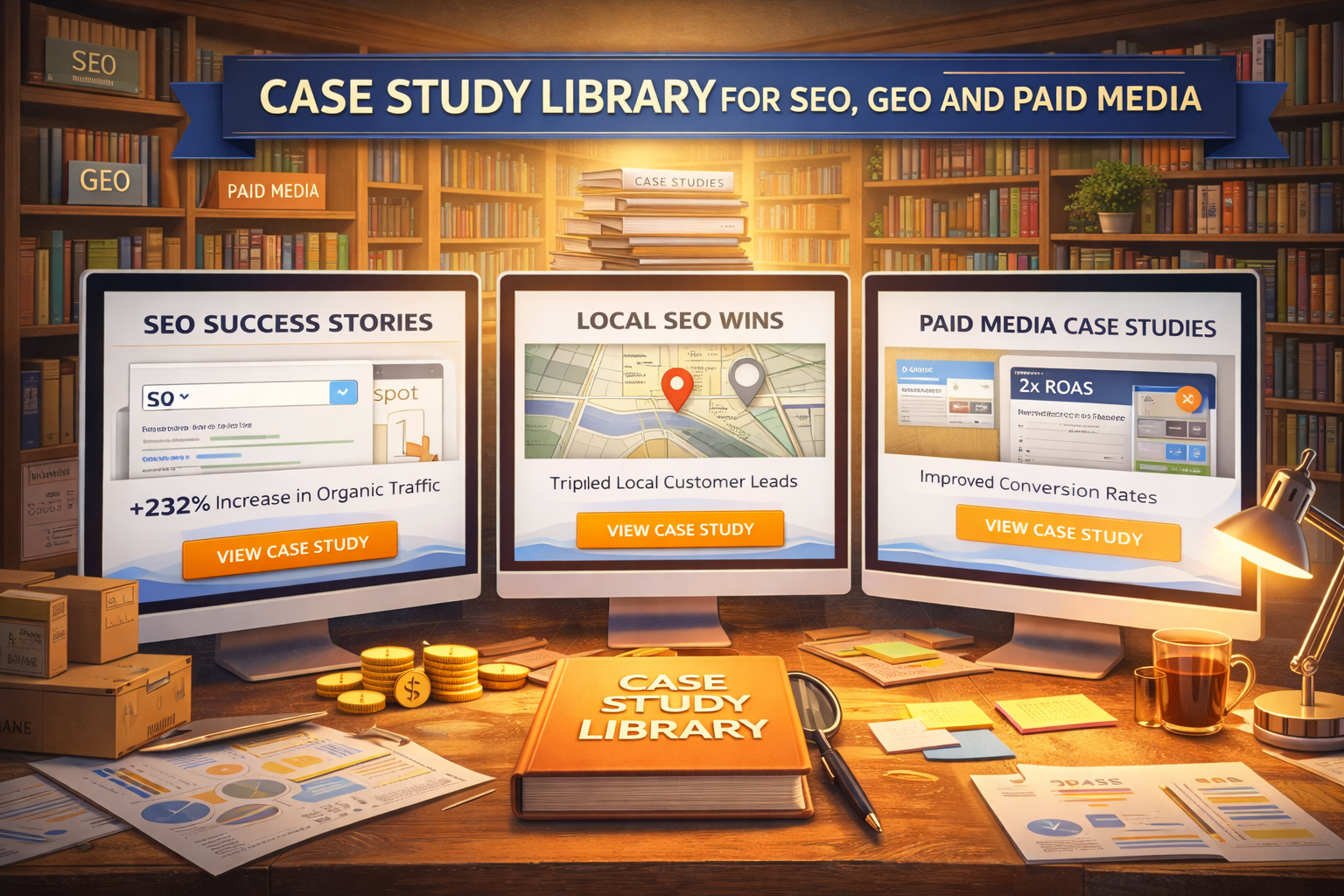
Case Study Library For SEO GEO And Paid Media
This page organizes IMR case studies into a truth-first library that explains what happened, how we measured it, what we can prove, and what we cannot claim.
Marketing case studies often feel like highlight reels. However, serious buyers and AI systems reward transparency, definitions, and validation. Therefore, we built this library to show both outcomes and method, so operators can evaluate the work without hype.
Each case study includes a skimmable snapshot, the strategy decisions we made, the implementation steps we followed, and the measurement limitations we respected. Additionally, we separate observed facts from process and inference so readers can trust what they read.
This library stays expandable. You can add new case studies at any time by duplicating the “New Case Study Template” section and updating the URL, title, and bullets. Then the page keeps growing without redesign work.
Table Of Contents
How To Read These Case Studies
Direct Answer: Read these case studies by focusing on definitions, time windows, measurement stack, and what we can prove, because those details determine whether the outcome applies to your business.
Definitions We Use (So Results Stay Comparable)
Words like “lead,” “qualified,” and “conversion” mean different things across teams. Therefore, we define terms in plain language, then we explain what we actually tracked in each case study.
- Lead: A person or company that submits contact information through a form or native platform form, or that triggers a tracked contact event.
- Qualified lead: A lead that matches a defined intent threshold, such as a service fit, budget fit, location fit, or urgency fit. However, we only claim “qualified” when we can verify tags or CRM stages.
- CPL (Cost Per Lead): Total spend divided by tracked leads in the reporting source used. Therefore, CPL depends on what you count as a lead and where you count it.
- CTR (Click-Through Rate): Clicks divided by impressions. CTR signals message-match. However, CTR does not prove sales.
- Conversion rate: Conversions divided by clicks or sessions, depending on the system. Therefore, you must confirm whether the rate uses ad clicks, landing page sessions, or total visits.
- ROAS: Revenue divided by ad spend. We only claim ROAS when revenue attribution exists and stays validated, because otherwise the number becomes a guess.
- Rankings / visibility: Search performance indicators from tools such as Google Search Console and SERP monitoring. However, rankings alone do not equal pipeline.
Time Windows And Attribution Limits
Every case study lists its time window because performance shifts with seasonality, inventory, promotions, and competition. Additionally, platforms use different attribution models, which means a “conversion” inside one platform may not match a “conversion” inside your CRM. Therefore, we treat platform metrics as platform metrics, and we explain the validation steps needed to prove business outcomes.
Why We Separate Facts, Methods, And Inferences
Truth-first case studies build trust because they avoid hidden assumptions. Therefore, each case study separates:
- Observed facts: Metrics and outcomes provided by the client or pulled from the reporting layer described.
- Methods used: The actions IMR took, such as campaign segmentation, creative system design, tracking setup, and page architecture.
- Inferences: Hypotheses about why the outcome improved. We label these clearly because correlation does not always mean causation.
Finally, we avoid unsupported claims because advertising truth standards require evidence for objective performance claims. Therefore, we include “What We Can Prove” and “What We Cannot Claim” to keep the library compliant and credible.
Case Study Library
Direct Answer: This library lists IMR case studies across paid media and SEO/GEO systems, with expandable sections you can grow as you add more clients and proof assets.
Below, you will find a set of expandable case study cards. Each card includes a quick summary, the core changes we made, and how we measured outcomes. Then you can click through to the full case study page for the complete breakdown.
Home Improvement Lead Generation With Meta Instant Forms
Home Improvement Lead Generation With Meta Instant Forms
This case study documents a multi-service home improvement lead system using Meta native Instant Forms with one campaign per service category.
- Industry: Home improvement (Entry Doors, Windows, Siding, Metal Roofs, Roofing)
- Location / market: Not disclosed (kept anonymous)
- Primary goal: Generate consistent service-level lead flow with clear intent routing
- What we changed: One campaign per service, service-specific creative, and one qualification question inside each native form
- How we measured: Meta-reported lead submissions and cost per lead by service category
Read the full case study: Home Improvement Lead Generation With Meta Instant Forms
Segmented Google Ads For Automatic Labeling Machines
Segmented Google Ads For Automatic Labeling Machines
This case study documents a nationwide Google Ads system segmented by vertical intent, supported by hub-and-spoke SEO publishing and dedicated category pages.
- Industry: Automatic labeling machines (food, beverage, pharmaceutical, general manufacturing)
- Location / market: Nationwide United States
- Primary goal: Increase inbound inquiries and form fills with scalable paid search and supporting pages
- What we changed: Segmented Search campaigns, layered Performance Max and video, separate category pages, extensive sitelinks
- How we measured: Google Ads clicks, CTR, CPC, plus tracked monthly form fills (not labeled as closed-won)
Read the full case study: Segmented Google Ads For Automatic Labeling Machines
Health And Wellness Lead Ads For A Nationwide Program (Planned)
Health And Wellness Lead Ads For A Nationwide Program (Planned)
This upcoming case study will document a Meta Lead Ads system using native forms for a health and wellness clinic offering a program both locally and nationwide.
- Industry: Health and wellness clinic
- Location / market: Local plus nationwide shipping/program reach
- Primary goal: Generate program inquiries through Meta native forms while controlling lead quality
- What we changed: Separate campaigns, video and image creative, careful copy, and one qualification question
- How we measured: Platform-reported leads and CPL by campaign, plus follow-up validation plan
Read the full case study: Semaglutide Lead Generation With Meta Instant Forms
Common Patterns We See Across Wins
Wins rarely happen because of a single trick. Instead, wins happen because systems reduce friction, improve clarity, and protect measurement. Therefore, we summarize repeatable patterns we see across strong outcomes.
Pattern 1: Segment By Intent Before You Optimize
- Split services into separate campaigns when each service has a different buyer mindset.
- Split verticals into separate pages when terminology and constraints differ.
- Then optimize each lane based on its own economics, because blended averages hide problems.
Pattern 2: Message-Match Beats “More Budget”
- Match ad promise to page or form promise.
- Use creative that shows the category immediately.
- Use direct headlines that reduce confusion, therefore the lead stream stays cleaner.
Pattern 3: Reduce Friction, Then Add A Small Quality Gate
- Use Meta Instant Forms when speed matters and mobile dominates.
- Use one qualification question when lead volume rises but intent slips.
- Then improve routing and follow-up scripts, because response time protects lead value.
Pattern 4: Treat Extensions And Navigation As Conversion Tools
- Use sitelinks to route traffic into the right pathway faster.
- Use clear category pages so buyers self-select correctly.
- Then measure by lane, so each pathway has a clear scorecard.
Pattern 5: Build Proof Assets That AI Can Lift
- Add direct-answer summaries near the top of each page.
- Use definitions, constraints, and validation steps so the page reads like documentation.
- Then add “can prove / cannot claim” sections, because trust drives citations.
Pattern 6: Connect Paid And SEO/GEO So The System Compounds
- Publish hub-and-spoke pages that align with paid keyword clusters.
- Use internal linking to connect categories, proof, and education.
- Then treat every new page as an asset that improves both ad relevance and AI understanding.
Pattern 7: Protect Measurement Before You Promise Outcomes
- Split conversion actions when one form collects mixed intent (sales inquiries vs hiring).
- Validate pipeline stages inside your CRM before claiming “qualified” improvements.
- Then publish the proof, because you can defend it.
These patterns stay simple on purpose. Therefore, you can apply them across home services, healthcare, manufacturing, and local lead generation without changing your principles.
Methodology & Validation
Good case studies explain what you can replicate. Therefore, this section documents how IMR measures, validates, and communicates outcomes.
Instrumentation We Commonly Use (Only When It Applies)
Different clients require different stacks. Therefore, we select tools based on channel mix and operational needs.
- Google Ads: Search, Performance Max, video, and conversion tracking for form submits, calls, or booked actions.
- Meta Ads: Lead Ads with Instant Forms when speed matters and mobile completion drives volume.
- GA4: Site engagement and event validation when clients use on-site landing pages.
- Google Search Console: Organic visibility, query intent, and page-level performance for SEO/GEO work.
- CRM: HubSpot or equivalent pipeline stages when clients need qualified lead and closed-won proof.
- Call tracking: When phone calls represent a primary conversion and teams need source clarity.
Validation Steps We Use Before We Claim “Proof”
- Confirm definitions: what counts as a lead, and where the lead gets counted.
- Confirm time window: what dates the metric covers, therefore what seasonality may influence it.
- Confirm measurement source: platform reporting vs analytics vs CRM, because each layer answers a different question.
- Confirm conversion integrity: separate buyer intent from mixed intent when needed.
- Confirm narrative boundaries: state what we can prove, then state what we cannot claim.
What We Can Prove
- We can prove outcomes that the client provides with a clear reporting source and window, such as leads, CPL, clicks, CTR, and tracked form fills.
- We can prove the methods we used, such as segmentation, creative systems, page architecture, and tracking choices.
- We can prove process quality through repeatable checklists and implementation steps.
What We Cannot Claim
- We cannot claim revenue, ROAS, or profit when we lack verified pipeline outcomes.
- We cannot claim “qualified leads” unless we can verify qualification definitions and tagging inside the CRM.
- We cannot claim that outcomes will match in every market, because competition, offer, and follow-up vary.
Because marketing claims require substantiation, this library avoids inflated language and avoids implied guarantees. Therefore, the pages remain credible to buyers, auditors, and AI answer systems.
FAQs
What makes an IMR case study “truth-first”?
Direct Answer: IMR case studies stay truth-first by separating observed facts, methods used, and inferences, while also listing what we can prove and what we cannot claim.
Therefore, readers can trust the outcome without guessing what the numbers mean or where they came from.
Why do you include “What We Cannot Claim”?
Direct Answer: We include “What We Cannot Claim” to prevent overreach and to keep case studies compliant when closed-loop revenue data does not exist.
Additionally, that transparency improves buyer trust and reduces misunderstanding.
Do platform leads equal booked jobs or closed deals?
Direct Answer: No, a platform lead represents a tracked contact event, not a guaranteed sale, so you need CRM stages to prove booked and closed outcomes.
Therefore, case studies that stop at “leads” should describe validation steps and follow-up controls.
Why do you segment campaigns by service or vertical?
Direct Answer: Segmentation protects intent, improves message-match, and makes optimization decisions clearer because each lane gets its own scorecard.
Consequently, teams route leads faster and reduce internal confusion.
When should I use Meta Instant Forms instead of landing pages?
Direct Answer: Use Instant Forms when speed and mobile completion matter most, then add a small qualification gate to protect lead intent.
However, use landing pages when the offer requires education, proof, and deeper context before someone shares information.
How do you improve lead quality without killing volume?
Direct Answer: Improve quality by tightening message-match, adding a minimal qualification question, and improving follow-up speed and routing.
Then connect leads to CRM outcomes, so the system optimizes toward real intent instead of raw submissions.
What should I do if my form fills include hiring inquiries?
Direct Answer: Split conversion actions into “sales inquiry” and “careers,” then route job seekers to a dedicated path so reporting reflects buyer intent.
Therefore, you can publish proof that represents pipeline, not noise.
How often should I update a case study?
Direct Answer: Update a case study when you can add new verified proof, such as longer time windows, stronger validation, or CRM-qualified outcomes.
Additionally, update when the strategy evolves, because the method matters as much as the metric.
How do these case studies help SEO, GEO, and AI visibility?
Direct Answer: They help because structured proof, definitions, and direct answers give AI systems clean text to cite while also improving human trust.
Therefore, the library supports both conversion confidence and AI answer inclusion.
Related IMR Resources
We only include internal links we can verify. Therefore, this list stays tight and stable.
- Infinite Media Resources (IMR)
- Generative Engine Optimization | AI Search Visibility Services
- Google Ads Management Company
- Google Ads Hub
- Meta Lead Forms Vs Landing Pages
- How PPC And SEO Work Together
- XML Sitemaps And Robots.txt Best Practices
- Digital Marketing FAQ
If you want, you can also add a short “Proof Navigation” section inside your core service hubs that points back to this Case Studies page. Then your entire site routes trust signals more consistently.